


Muhammed Irfan • Nov 11, 2026
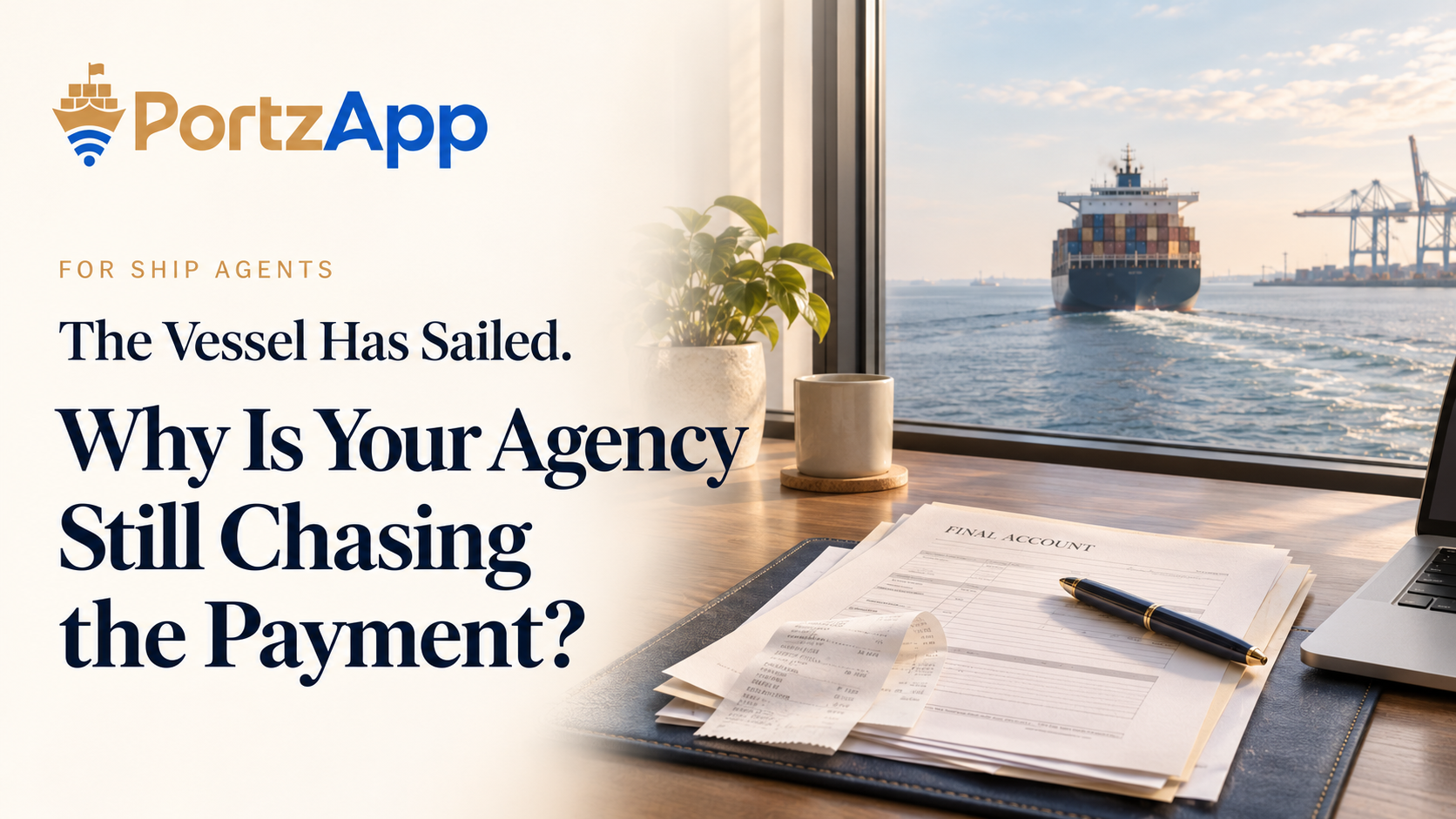
The vessel has sailed. Your team arranged the services, coordinated the providers and handled the changes that came with the call. The final disbursement account is submitted. Your attention should be on the next arrival.
Instead, someone needs another receipt. A charge is being questioned. A provider wants to know when they will be paid. Finance asks operations to explain a decision made several days earlier, while operations is already dealing with another vessel.
For a ship agency, departure and financial completion can be very different milestones. The service may be finished, but the responsibility for explaining it—and, where costs have been advanced, the financial exposure—can remain with the agent.
A completed port call can leave several unfinished tasks
Consider an illustrative call involving provisions, a launch service and a survey. Your agency collects the requirements, obtains prices, coordinates the appointments and prepares the proforma disbursement account, or PDA.
During the call, one arrangement changes. The revised timing is discussed by phone. A provider sends an updated amount by email. A delivery acknowledgement reaches another member of the team. Each person has handled their part, but the record is spread across different places.
After departure, the final disbursement account, or FDA, needs to reflect the actual work and its supporting documents. A reviewer asks why one amount differs from the estimate. Answering requires the original quote, the revised instruction and the relevant delivery record.
None of those documents may be missing. The problem is that their connection is missing. Your team has to assemble it again before the other party can understand the charge.
The cost of an open account goes beyond the unpaid balance
Where an agency advances provider costs or port charges, delayed settlement leaves its money committed to work already completed. At the same time, the next call brings new arrangements and new commitments.
There is also a cost in staff attention. A finance colleague searches for a receipt. An operations colleague contacts a provider. Someone checks which version of the estimate was sent. A manager steps in when the exchange becomes difficult.
That work can repeat across several open accounts. The result is a growing overlap between current operations and unfinished financial administration.
It also affects relationships. A provider asking for payment needs a clear answer. A principal reviewing a charge needs sufficient evidence. The agent is often the person connecting both conversations, even when the information needed to resolve them sits elsewhere.
Why sending another invoice does not resolve every query
Following up on payment is necessary, but the reason an account remains open matters. A reviewer may need evidence of delivery, an explanation for a revised service or confirmation of what was included in the approved estimate.
Those are different questions. Sending the same invoice again does not necessarily answer them.
A useful response connects the charge to its basis: what was requested, what was quoted, what changed, and what was delivered. That connection is much easier to explain when it has been maintained during the job.
This does not mean every difference between a PDA and FDA is an error. An estimate and an account of actual work can differ. The practical question is whether the parties can identify the reason and review the evidence without reconstructing the entire call.
Start the settlement record before the vessel arrives
A clearer finish begins with a clearer starting point. The agency and principal need a shared understanding of the requested services, the pricing basis and the payment arrangement.
The operational team also needs to know where to record changes and keep supporting documents. Otherwise, the most important details can remain with the person who took the call or received the message.
For example, if a service is revised, keep the new instruction and its cost implications alongside the original arrangement. When delivery is completed, associate the acknowledgement or receipt with the relevant work. These records give finance context when it prepares the final account.
The aim is to make documentation part of managing the port call. Waiting until departure to collect the story creates another job at precisely the moment everyone is moving on.
How PortzApp connects agency operations and the account
PortzApp brings quoting, order activity, communication and financial documentation into a shared workflow. For an agency, the value is being able to follow the relationship between the arrangement and the charge.
PDA and FDA preparation can draw on the operational records, with supporting documents associated with the relevant items. A question about a charge can therefore start with the corresponding job and its documentation.
Order-specific communication helps retain the context around the work. Instructions, clarifications and updates can stay with the order, giving the people involved a common reference.
PortzApp’s finance and accounting module goes beyond per-order revenue and expense tracking, giving ship agents a more complete way to manage their finances within PortzApp without needing separate finance software. This internal view complements the financial records used to explain charges to principals.
The benefit depends on keeping the record current. A workspace becomes useful when the team records the changes and documents that would otherwise stay in separate conversations.
Where escrow fits into the payment arrangement
Documentation and payment funding address different parts of the problem. A well-supported account helps explain the charge. Funding arrangements establish how payment will be supported.
PortzApp offers escrow-backed settlement. For a transaction funded through escrow, funds are held against the arrangement and released according to the applicable delivery and documentation conditions.
The important starting point is a funded transaction, together with a clear understanding of those conditions. An invoice alone does not establish that funds have been secured.
For the agent, connecting the funded arrangement with the operational record creates a clearer basis for proceeding and for documenting completion. It does not make every possible disagreement disappear; it gives the parties a defined process and a record against which to address the work.
What a clearer close-out looks like
Imagine the same illustrative call with the records kept together. The original quote is accessible. The revised instruction is associated with the service. The delivery evidence is attached to the relevant item.
When the principal asks about the difference, your team can point to those records. Finance can review the explanation without first asking operations to reconstruct it. The conversation becomes about a specific item and the evidence supporting it.
That is a practical improvement to assess. How many follow-ups were needed to locate documents? Which queries could be answered directly from the record? What remained unresolved, and why?
Those answers reveal where the workflow is helping and where the team still needs a clearer handoff.
Try it on one port call
Start with one call where operations and finance can work from the same record. Establish the payment arrangement early, capture service changes as they happen and keep supporting documents with the work.
Then follow the account through to settlement. Assess whether your team can explain the final charges more easily and spend less time searching for information after departure.
Your agency already does the work of bringing the port call together. Its records should help carry that work through to a clear financial finish.
See PortzApp’s workflow for ship agents → https://portzapp.com/solutions/ship-agents