
The PDA-to-FDA Overrun
Muhammed Irfan • Aug 11, 2026
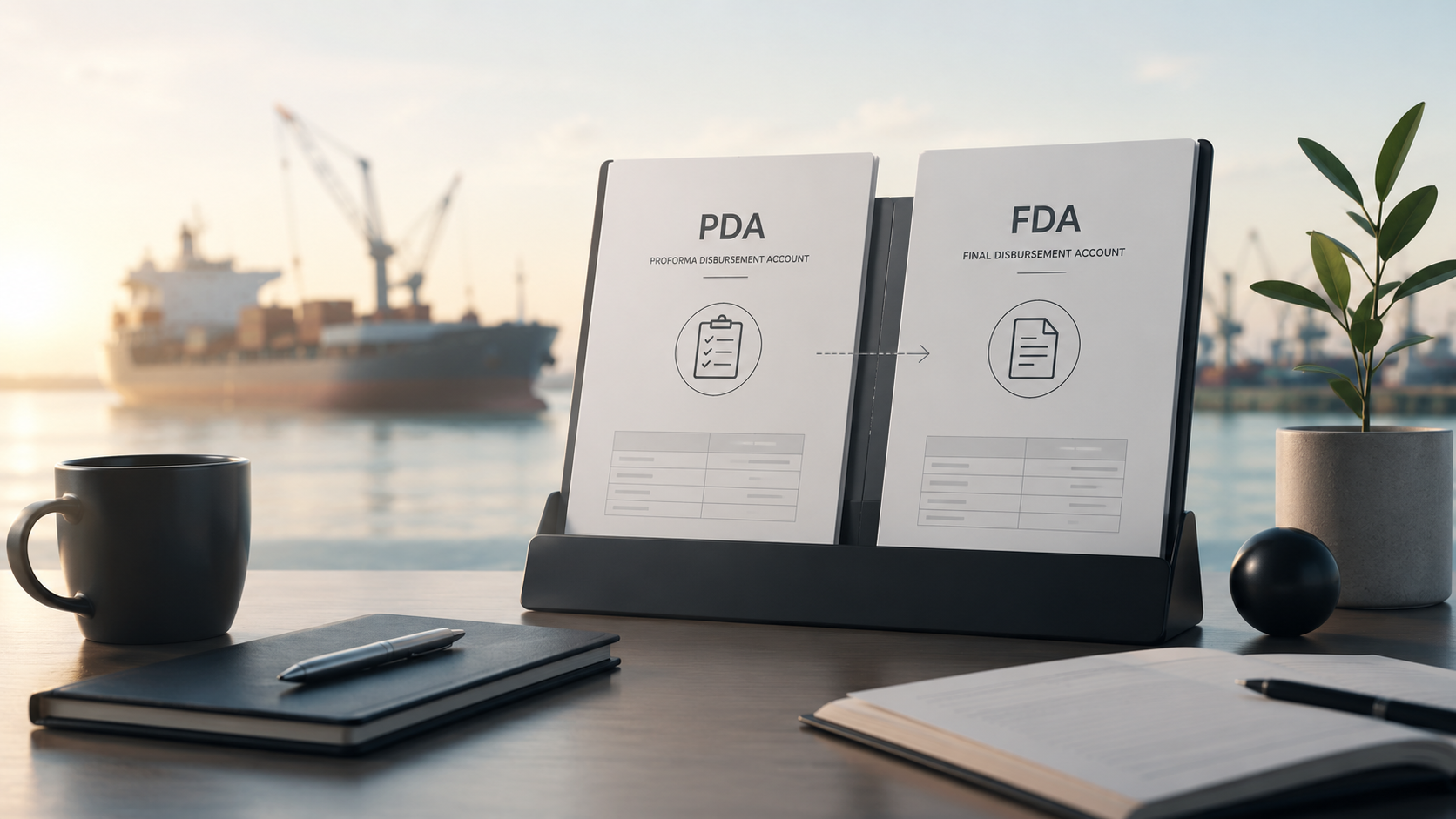
You approve the PDA. Weeks later, the vessel has sailed and the FDA lands in your inbox — and it's higher. Not by a rounding error. By 10-15%, on average, across the industry. Every owner budgeting a port call knows this pattern, and most have simply built it into the budget rather than fixed it.
The gap, specifically
A port call touches five to ten service providers — the agent, the chandler, the surveyor, tugboat operators, stevedores. Each one quotes separately, in their own format, through their own inbox. Someone on your team (or your agent's team) manually assembles those quotes into a proforma disbursement account. Then, after the vessel sails, the actual invoices come in — also separately, also in different formats — and get reconciled against that PDA line by line, usually in a spreadsheet, usually under time pressure to close the account.
Somewhere in that manual assembly and reconciliation, discrepancies creep in. A line item quoted as a flat fee comes back itemized. A "standard" charge turns out to carry a surcharge nobody flagged. By the time someone notices, the vessel has moved on, the provider considers the job closed, and disputing a line item costs more in time than the line item itself.
Why this isn't a one-off — it's structural
This isn't dishonesty from any one provider. It's what happens when nothing about the quote-to-invoice pipeline is standardized or traceable. There's no shared record between the PDA and the FDA — just two documents produced independently, by different people, at different times, with no line-item link between them. Nobody verifies the final invoice against the approved quote at the point where a discrepancy could actually be caught. By the time it's caught, it's a dispute, not a correction.
What it actually costs
The 10-15% overrun isn't the only cost. There's the time spent manually reconciling PDAs against FDAs across every vessel in the fleet. There's the friction of disputing a line item after the fact, with a provider who's already delivered the service and has no incentive to revisit it. And there's the budgeting problem: if every port call runs 10-15% over what was approved, that's not an occasional line item — it's a structural markup on every port call you run, fleet-wide.
How PortzApp closes the gap
The fix isn't a better spreadsheet. It's removing the gap between quote and invoice entirely. On PortzApp, every provider submits a structured quote through the platform, not through email. That quote becomes the PDA. Every job tracked from that PDA carries its line items forward automatically, so the FDA is built from the same structured data — not re-entered, not re-formatted, not retyped into a new document. Every invoice line traces back to the job and the document that generated it. If a provider's invoice doesn't match what they quoted, it's visible immediately — not three weeks later during a fleet-wide reconciliation.
Auditing the gap vs. preventing it
Most tools in this space — DA-Desk, Harbor Lab — help you audit disbursements after they've already happened. That's useful, but it's downstream of the actual problem. PortzApp works upstream: the structured quote is the PDA, the tracked job is the audit trail, and the FDA is generated from the same record instead of reconciled against it after the fact. The overrun doesn't get caught later. It doesn't get a chance to happen.
See it on your next port call
You don't need to migrate your whole fleet to test this. Run a single port call through PortzApp's structured quoting and PDA/FDA builder, and compare the outcome to your usual process. The Standard plan is free — there's no cost to see whether the 10-15% gap closes on your very first job.
See how structured quoting works for vessel owners → https://portzapp.com/solutions/vessel-owners